Monday, February 18, 2019

Washington State information and facts

Image result for ws state info factsMap of Washington (state)

Capital: Olympia

State abbreviation/Postal code: Wash./WA

U.S. Representatives: 10

Historical biographies of Congressional members

Organized as territory: March 2, 1853

Entered Union (rank): Nov. 11, 1889 (42)

Present constitution adopted: 1889

Motto: Al-Ki (Indian word meaning “by and by”)

State symbols:

flower coast rhododendron (1892)
tree western hemlock (1947)
bird willow goldfinch (1951)
fish steelhead trout (1969)
gem petrified wood (1975)
colors green and gold (1925)
song “Washington, My Home” (1959)
folk song “Roll On Columbia, Roll On” (1987)
dance square dance (1979)
grass bluebunch wheatgrass (1989)
insect blue darner dragonfly (1997)
fossil Columbian mammoth (1998)
fruit apple (1989)
Nicknames: Evergreen State

Origin of name: In honor of George Washington

10 largest cities (2010 est.): Seattle, 608,660; Spokane, 208,916; Tacoma, 198,397; Vancouver , 161,791; Bellevue, 122,363; Everett, 103,019; Kent, 92,411; Yakima, 91,067; Renton, 90,927; Spokane Valley, 89,755

Land area: 71,362 sq mi (184,827 km2

Geographic center: In Chelan Co., 10 mi. WSW of Wenatchee

Number of counties: 39

Largest county by population and area: King, 1,931,249 (2010); Okanogan, 5,268 sq mi.

State forest lands: 2.1 million ac.

State parks: 120

Residents: Washingtonian

2016 resident population est.: 7,288,000

2010 resident census population (rank): 6,724,540 (13). Male: 3,349,707 (49.8%); Female: 3,374,833 (50.2%). White: 5,196,362 (77.3%); Black: 240,042 (3.6%); American Indian: 103,869 (1.5%); Asian: 481,067 (7.2%); Other race: 349,799 (5.2%); Two or more races: 312,926 (4.7%); Hispanic/Latino: 755,790 (11.2%). 2010 percent population 18 and over: 76.5; 65 and over: 12.3; median age: 37.3.


Map of Washington
Map of Washington
As part of the vast Oregon Country, Washington territory was visited by Spanish, American, and British explorers—Bruno Heceta for Spain in 1775, the American Capt. Robert Gray in 1792, and Capt. George Vancouver for Britain in 1792–1794. Lewis and Clark explored the Columbia River region and coastal areas for the U.S. in 1805–1806.

Rival American and British settlers and conflicting territorial claims threatened war in the early 1840s. However, in 1846 the Oregon Treaty set the boundary at the 49th parallel and war was averted.

Washington is a leading lumber producer. Its rugged surface is rich in stands of Douglas fir, hemlock, ponderosa and white pine, spruce, larch, and cedar. The state holds first place in apples, lentils, dry edible peas, hops, pears, red raspberries, spearmint oil, and sweet cherries, and ranks high in apricots, asparagus, grapes, peppermint oil, and potatoes. Livestock and livestock products make important contributions to total farm revenue and the commercial fishing catch of salmon, halibut, and bottomfish makes a significant contribution to the state's economy.

Manufacturing industries in Washington include aircraft and missiles, shipbuilding and other transportation equipment, lumber, food processing, metals and metal products, chemicals, and machinery.

Washington has over 1,000 dams, including the Grand Coulee, built for a variety of purposes including irrigation, power, flood control, and water storage.

Among the major points of interest: Mt. Rainier, Olympic, and North Cascades National Parks. Mount St. Helens, a peak in the Cascade Range, erupted in May 1980. Also of interest are Whitman Mission and Fort Vancouver National Historic Sites; and the Pacific Science Center and the Space Needle, in Seattle.

As of 2013, Washington is the only state where cannabis, same-sex marriage, and assisted suicide are all legal. In 2008, the Washington Death with Dignity Act was passed, allowing legal assisted suicide. In the November 2012 general election, voters upheld Referendum 74, a bill that legalized same-sex marriage in Washington. Also in November 2012, Washington passed Initiative 50, making the sale and possession of marijuana (in limited amounts) for both medical and non-medical purposes legal.


Selected famous natives and residents:
Sherman Alexie author;
Earl Anthony professional bowler;
Mildred Bailey singer;
Bob Barker TV host;
Dyan Cannon actress;
Raymond Carver writer;
Carol Channing actress;
Ray Charles singer and musician;
Kurt Cobain rock musician;
Judy Collins singer;
Chris Cornell rock musician;
Fred Couples professional golfer;
Bing Crosby singer and actor;
Bob Crosby musician;
Merce Cunningham choreographer;
Howard Duff actor;
John Elway football player;
Frances Farmer actress;
Kenny G. saxophonist;
Bill Gates software executive;
Jimi Hendrix guitarist;
Frank Herbert writer;
Robert Joffrey choreographer;
Chuck Jones animator;
Quincy Jones music producer;
Hank Ketcham cartoonist;
Amanda Knox Italian murder suspect known as "Foxy Knoxy";
Gary Larson cartoonist;
Gypsy Rose Lee entertainer;
Tim Lincecum professional baseball pitcher;
Kenny Loggins rock musician;
Mary McCarthy novelist;
Guthrie McClintic theatrical producer and director;
John McIntire actor;
Steve Miller rock musician;
Robert Motherwell artist;
Patrice Munsel soprano;
Craig T. Nelson actor;
Ella Raines actress;
Ahmad Rashad football player;
Ann Reinking dancer and actress;
Tom Robbins novelist;
Ann Rule writer;
Francis Scobee astronaut;
Hope Solo soccer goalkeeper;
Seattle Suquamish chief;
Smohalla Indian prophet and chief;
Hilary Swank actress;
Julia Sweeney actress;
Adam West actor;
Audrey Wurdemann poet.
Sunday, February 17, 2019

Presidents' Day


Image result for presidents day 2019
Image result for presidents day 2019Image result for presidents day 2019


Presidents Day is an American holiday celebrated on the third Monday in February; Presidents Day 2019 occurs on Monday, February 18. Originally established in 1885 in recognition of President George Washington, the holiday became popularly known as Presidents Day after it was moved as part of 1971’s Uniform Monday Holiday Act, an attempt to create more three-day weekends for the nation’s workers. While several states still have individual holidays honoring the birthdays of Washington, Abraham Lincoln and other figures, Presidents Day is now popularly viewed as a day to celebrate all U.S. presidents, past and present.

Washington’s Birthday
The story of Presidents Day date begins in 1800. Following the death of George Washington in 1799, his February 22 birthday became a perennial day of remembrance.

At the time, Washington was venerated as the most important figure in American history, and events like the 1832 centennial of his birth and the start of construction of the Washington Monument in 1848 were cause for national celebration.

While Washington’s Birthday was an unofficial observance for most of the 1800s, it was not until the late 1870s that it became a federal holiday. Senator Steven Wallace Dorsey of Arkansas was the first to propose the measure, and in 1879 President Rutherford B. Hayes signed it into law.

The holiday initially only applied to the District of Columbia, but in 1885 it was expanded to the whole country. At the time, Washington’s Birthday joined four other nationally recognized federal bank holidays—Christmas Day, New Year’s Day, the Fourth of July and Thanksgiving—and was the first to celebrate the life of an individual American. Martin Luther King Jr. Day, signed into law in 1983, was the second.

Uniform Monday Holiday Act
The shift from Washington’s Birthday to Presidents Day began in the late 1960s, when Congress proposed a measure known as the Uniform Monday Holiday Act. Championed by Senator Robert McClory of Illinois, this law sought to shift the celebration of several federal holidays from specific dates to a series of predetermined Mondays.

The proposed change was seen by many as a novel way to create more three-day weekends for the nation’s workers, and it was believed that ensuring holidays always fell on the same weekday would reduce employee absenteeism. While some argued that shifting holidays from their original dates would cheapen their meaning, the bill also had widespread support from both the private sector and labor unions and was seen as a surefire way to bolster retail sales.

The Uniform Monday Holiday Act also included a provision to combine the celebration of Washington’s birthday with that of Abraham Lincoln, which fell on February 12. Lincoln’s Birthday had long been a state holiday in places like Illinois, and many supported joining the two days as a way of giving equal recognition to two of America’s most famous statesmen.

McClory was among the measure’s major proponents, and he even floated the idea of renaming the holiday Presidents Day. This proved to be a point of contention for lawmakers from George Washington’s home state of Virginia, and the proposal was eventually dropped.

Nevertheless, the main piece of the Uniform Monday Holiday Act passed in 1968 and officially took effect in 1971 following an executive order from President Richard M. Nixon. Washington’s Birthday was then shifted from the fixed date of February 22 to the third Monday of February. Columbus Day, Memorial Day and Veterans Day were also moved from their traditionally designated dates. (As a result of widespread criticism, in 1980 Veterans’ Day was returned to its original November 11 date.)


Did you know? President's Day never falls on the actual birthday of any American president. Four chief executives—George Washington, William Henry Harrison, Abraham Lincoln and Ronald Reagan—were born in February, but their birthdays all come either too early or late to coincide with Presidents Day, which is always celebrated on the third Monday of the month.


Presidents Day Transformed
While Nixon’s order plainly called the newly placed holiday Washington’s Birthday, it was not long before the shift to Presidents Day began.

The move away from February 22 led many to believe that the new date was intended to honor both Washington and Lincoln, as it now fell between their two birthdays. Marketers soon jumped at the opportunity to play up the three-day weekend with sales, and “Presidents Day” bargains were advertised at stores around the country.

By the mid-1980s, Washington’s Birthday was known to many Americans as Presidents Day. This shift had solidified in the early 2000s, by which time as many as half the 50 states had changed the holiday’s name to Presidents Day on their calendars.

Some states have even chosen to customize the holiday by adding new figures to the celebration. Arkansas, for instance, celebrates Washington as well as civil rights activist Daisy Gatson Bates. Alabama, meanwhile, uses Presidents Day to commemorate Washington and Thomas Jefferson (who was born in April).

Washington and Lincoln still remain the two most recognized leaders, but Presidents Day is now popularly seen as a day to recognize the lives and achievements of all of America’s chief executives. Some lawmakers have objected to this view, arguing that grouping George Washington and Abraham Lincoln together with less successful presidents minimizes their legacies.

Congressional measures to restore Washington and Lincoln’s individual birthdays were proposed during the early 2000s, but all failed to gain much attention. For its part, the federal government has held fast to the original incarnation of the holiday as a celebration of the country’s first president. The third Monday in February is still listed on official calendars as Washington’s Birthday.

Presidents Day Celebrations and Traditions
Like Independence Day, Presidents Day is traditionally viewed as a time of patriotic celebration and remembrance. In its original incarnation as Washington’s Birthday, the holiday gained special meaning during the difficulties of the Great Depression, when portraits of George Washington often graced the front pages of newspapers and magazines every February 22.

In 1932, the date was used to reinstate the Purple Heart, a military decoration originally created by George Washington to honor soldiers killed or wounded while serving in the armed forces. Patriotic groups and the Boy Scouts of America also held celebrations on the day, and in 1938 some 5,000 people attended mass at Saint Patrick’s Cathedral in New York City in honor of Washington.

In its modern form, Presidents Day is used by many patriotic and historical groups as a date for staging celebrations, reenactments and other events. A number of states also require that their public schools spend the days leading up to Presidents Day teaching students about the accomplishments of the presidents, often with a focus on the lives of Washington and Lincoln.


Saturday, February 16, 2019

Montanta State Information

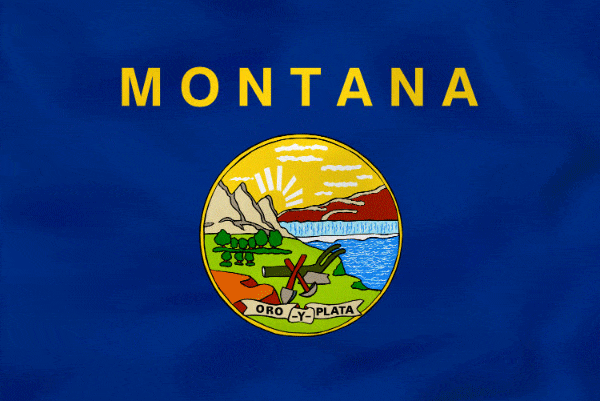
Montana flag

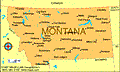
Map of Montana

Capital: Helena

State abbreviation/Postal code: Mont./MT

U.S. Representatives: 1

Historical biographies of Congressional members

Organized as territory: May 26, 1864

Entered Union (rank): Nov. 8, 1889 (41)

Present constitution adopted: 1972

Motto: Oro y plata (Gold and silver)

State symbols:

flower bitterroot (1895)
tree ponderosa pine (1949)
stones sapphire and agate (1969)
bird Western meadowlark (1981)
song “Montana” (1945)
Nickname: Treasure State

Origin of name: From the Spanish word meaning “mountain.”

10 largest cities (2012): Billings, 106,954; Missoula, 68,394; Great Falls, 58,893; Bozeman, 38,695; Butte-Silver Bow,1 33,730; Helena , 29,134; Kalispell, 20,487; Upper Yellowstone Valley, 12,251; Havre, 9,620; Blackfeet, 9,319

Land area: 145,552 sq mi. (376,980 sq km)

Geographic center: In Fergus Co., 11 mi. W of Lewistown

Number of counties: 56

Largest county by population and area: Yellowstone, 147,972 (2010); Beaverhead, 5,543 sq mi.

State forests: 7

State parks: 50

Residents: Montanan

2015 resident population est.: 1,032,949


Montana Facts and Trivia

  1. Montana has the largest migratory elk herd in the nation.
  2. The state boasts the largest breeding population of trumpeter swans in the lower United States.
  3. At the Rocky Mountain Front Eagle Migration Area west of Great Falls more golden eagles have been seen in a single day than anywhere else in the country.
  4. North of Missoula is the largest population of nesting common loons in the western United States.
  5. The average square mile of land contains 1.4 elk, 1.4 pronghorn antelope, and 3.3 deer.
  6. The Freezeout Lake Wildlife Management Area contains as many as 300,000 snow geese and 10,000 tundra swans during migration.
  7. At Bowdoin National Wildlife Refuge it is possible to see up to 1,700 nesting pelicans.
  8. The Montana Yogo Sapphire is the only North American gem to be included in the Crown Jewels of England.
  9. In 1888 Helena had more millionaires per capita than any other city in the world.
  10. 46 out of Montana's 56 counties are considered "frontier counties" with an average population of 6 or fewer people per square mile.
  11. At Egg Mountain near Choteau dinosaur eggs have been discovered supporting the theory some dinosaurs were more like mammals and birds than like reptiles.
  12. Montana is the only state with a triple divide allowing water to flow into the Pacific, Atlantic, and Hudson Bay. This phenomenon occurs at Triple Divide Peak in Glacier National Park.
  13. The notorious outlaw, Henry Plummer, built the first jail constructed in the state.
  14. No state has as many different species of mammals as Montana.
  15. The moose, now numbering over 8,000 in Montana, was thought to be extinct in the Rockies south of Canada in the 1900s.
  16. Flathead Lake in northwest Montana contains over 200 square miles of water and 185 miles of shoreline. It is considered the largest natural freshwater lake in the west.
  17. Miles City is known as the Cowboy Capitol.
  18. Yellowstone National Park in southern Montana and northern Wyoming was the first national park in the nation.
  19. The town of Ekalaka was named for the daughter of the famous Sioux chief, Sitting Bull.
  20. Fife is named after the type of wheat grown in the area or, as some locals contend, by Tommy Simpson for his home in Scotland.
  21. Fishtail is named for either a Mr. Fishtail who lived in the area or as the area Indians prefer for some of the peaks in the nearby Beartooth Mountain Range which look like the tail of a fish.
  22. The Yaak community is the most northwestern settlement in the state.
  23. Montana has the largest grizzly bear population in the lower 48 states.
  24. Near the Pines Recreation Area as many as 100 sage grouse perform their extraordinary spring mating rituals.
  25. The first luge run in North America was built at Lolo Hot Springs on Lolo Pass in 1965.
  26. Combination, Comet, Keystone, Black Pine, and Pony are names of Montana ghost towns.
  27. Virginia City was founded in 1863 and is considered to be the most complete original town of its kind in the United States.
  28. Montana is nicknamed the Treasure State.
  29. The bitterroot is the official state flower.
  30. The density of the state is six people per square mile.
  31. The highest point in the state is Granite Peak at 12,799 feet.
  32. The most visited place in Montana is Glacier National Park, known as the crown jewel of the continent. It lies along Montana's northern border and adjoins Waterton Lakes National Park in Canada, forming the world's first International Peace Park.
  33. Buffalo in the wild can still be viewed at the National Bison Range in Moiese, south of Flathead Lake and west of the Mission Mountains.
  34. Montana's first territorial capital, Bannack, has been preserved as a ghost town state park along once gold-laden Grasshopper Creek.
  35. The Old West comes to life through the brush and sculpture of famed western artist Charlie Russell at the Charles M. Russell Museum Complex in Great Falls. The museum contains the world's largest collection of Russell's work, his original log-cabin studio and his Great Falls home.
  36. The Museum of the Rockies in Bozeman gained fame through the work of its chief paleontologist, Jack Horner. Horner was the prototype for the character Dr. Alan Grant in the best selling novel/movie, "Jurassic Park."
  37. Montana's rivers and streams provide water for three oceans and three of the North American continent's major river basins.
  38. Just south of Billings, Lt. Col. George Armstrong Custer and his troops made their last stand. Little Bighorn Battlefield National Monument features the Plains Indians and United States military involved in the historic battle.
  39. The western meadowlark is the official state bird.
  40. The first inhabitants of Montana were the Plains Indians.
  41. Montana is home to seven Indian reservations.
  42. Every spring nearly 10,000 white pelicans with a wingspan of nine feet migrate from the Gulf of Mexico to Medicine Lake in northeastern Montana.
  43. The Going to the Sun Road in Glacier Park is considered one of the most scenic drives in America.
  44. The state's official animal is the grizzly bear.
  45. The state's motto Oro y Plata means gold and silver.
  46. Montana's name comes from the Spanish word mountain.
  47. In Montana the elk, deer and antelope populations outnumber the humans.
  48. Glacier National Park has 250 lakes within its boundaries.
  49. Hill County has the largest county park in the United States. Beaver Creek Park measures 10 miles long and 1 mile wide.
  50. Competing with the D River in Lincoln City, Oregon for the title of the world's shortest river, the Roe River flows near Great Falls. Both rivers lengths vary from 58 feet to 200 feet. The source for this small river is Giant Springs, the largest freshwater spring in the United States.
Thanks to: 7mbuell, Joel & Katrina, Travel Montana