Showing posts with label homeschool. Show all posts

Thursday, June 1, 2023

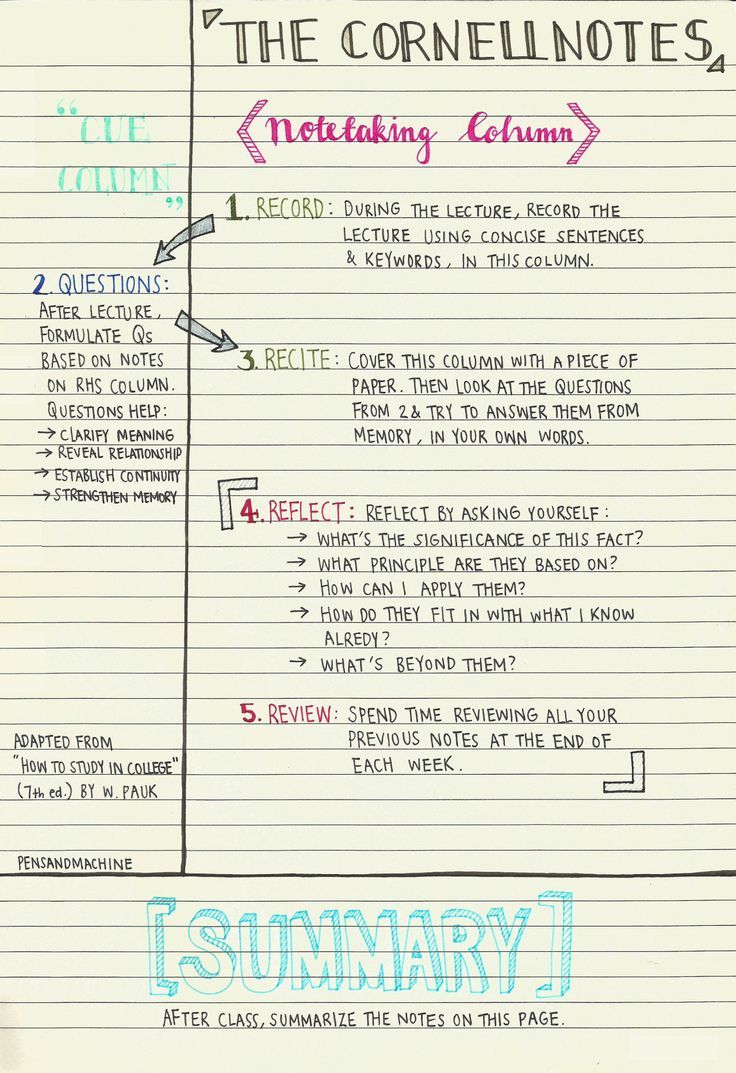
The Cornell Note-Taking Method

 What are the 5 R's in note-taking?

There are many ways to take notes, and everyone seems to have their preference when it comes to note-taking. Many methods involve some or all of the 5 R's of note-taking: record, reduce, recite, reflect, and review.


Five primary methods of note-taking: charts, lists, outlines, concept maps, and the Cornell method.


A blank Cornell notes template for the famous note-taking method invented by Professor Walter Pauk in the 1940s. The Cornell notes paper is divided into two columns, one on the right for note-taking and one on the left for questions/key points. The bottom of the page is reserved for the summary.  Dimensions: 8.5 x 11 inches.


Note-Taking Area: Record the lecture as fully and as meaningfully as possible.


Cue Column: As you’re taking notes, keep the cue column empty. Soon after the lecture, reduce your notes to concise jottings as clues for Reciting, Reviewing, and Reflecting.


Summaries: Sum up each page of your notes in a sentence or two.


This format provides the perfect opportunity for following through with the 5 R’s of note-taking:


Record

During the lecture, record in the main column as many meaningful facts and ideas as you can. Write legibly.

Reduce

As soon as possible, summarize these facts and ideas concisely in the Cue Column. Summarizing clarifies meanings and relationships, reinforces continuity, and strengthens memory.

Recite

Cover the Note-Taking Area, using only your jottings in the Cue Column, say over the facts and ideas of the lecture as fully as you can, not mechanically, but in your own words. Then, verify what you have said.

Reflect

Draw out opinions from your notes and use them as a starting point for your own reflections on the course and how it relates to your other courses. Reflection will help prevent ideas from being inert and soon forgotten.

Review

Spend 10 minutes every week in a quick review of your notes, and you will retain most of what you have learned.

Adapted from How to Study in College 7/e by Walter Pauk, 2001 Houghton Mifflin Company


What is a note-taker called?

A stenographer is an amanuensis. Anyone who can copy or write down what someone else is saying is considered an amanuensis. So if you've ever taken good notes in class, then you're an amanuensis!


Saturday, January 15, 2022

HOMESCHOOL winter break UPDATE - 2022


HOMESCHOOLING UNSCHOOLERS


We are homeschooling with Amazon Prime this semester.

You can find a lot of #FREEBIESONAMAZON

If you have a FIRETV log into your account and start learning.


 AMAZON PRIME READING 

Unlimited reading on any device. 

#books #magazones #audible 


FREE READING MATERIAL 

Browse the catalog of over 800 courses

Anne of Green Gables (AmazonClassics Edition)

Eleven-year-old orphan Anne Shirley has just arrived at Green Gables, and already her guardians want 
to send her back. First, she’s not the boy the Cuthberts expected. Second, she talks too much. And even 
with her generous spirit, the redhead’s a trouble magnet. She gets the neighbor drunk and nearly poisons 
the pastor!

Still, despite a rocky start, the fiery Anne wins over her guardians and her new community. She enjoys 
life at Green Gables, excels in school, and earns a coveted scholarship. But when tragedy hits, Anne 
must choose between her dreams and the only home she’s ever known.

In this beloved coming-of-age story, Lucy Maud Montgomery drew from her own experiences growing up 
in Canada during the nineteenth century to introduce generations of readers to one of literature’s most 
original and inspiring characters.
Pragmatic gambler Phileas Fogg has made a gentlemanly wager to the members of his exclusive club: 
that he can circle the world in just eighty days, right down to the minute. Fetching his newly appointed 
French valet, Fogg embarks on a fabulous journey across land and sea—by steamer, rail, and elephant
—to win the bet of a lifetime.

Inspired by Jules Verne’s own sea travels and his fascination with circumnavigating the globe.

AMAZON COURSES

The Great Courses Signature Collection

Amazon Prime members will now have the option to subscribe to The Great Courses Signature Collection on Amazon Video and view all the great premium content they have to offer.


https://www.thegreatcourses.com/courses/

Check out the programs with your young learners. Do they see anything interesting? You'll notice, it provides a wide variety of high-quality, college-style lecture courses

https://www.thegreatcourses.com/courses/types/individual-courses/category/programs-for-young-learners/sort-by/news_from_date

Did you notice the prices? $39.95 

If you have a subscription for only the length of a free trial definitely check out some of these documentaries. 


#amazonlinks

#ad

This post contains affiliate links. Click here for my affiliate disclosure. If you purchase items through my affiliate links, I receive a small commission but your price doesn't change. Thank You!!


Wednesday, April 28, 2021

Heart of Darkness by Joseph Conrad (audio and pdf available)


Click the photo or link to take you to my Amazon Storefront

https://amzn.to/3gIzCcT


Heart of Darkness

by Joseph Conrad

Heart of Darkness (1899) is a novella by Polish-English novelist Joseph Conrad about a narrated voyage up the Congo River into the Congo Free State in the Heart of Africa. Charles Marlow, the narrator, tells his story to friends aboard a boat anchored on the River Thames.


https://wjccschools.org/wp-content/uploads/sites/2/2016/02/Heart_of_Darkness-1.pdf

Joseph Conrad’s short novel Heart of Darkness is widely considered one of the richest examples of the use of symbolism in modern literature. Though the story is a mere fraction of a normal novel’s length, Conrad’s dense, layered prose can make for a slow and potentially frustrating—though ultimately rewarding—reading experience. The main story is centered on a riverboat pilot named Marlow who signs on to work for a Belgian company making inroads into the African Congo. Once he reaches Africa, Marlow’s piloting job transforms into a quest to locate a mysterious company employee named Kurtz who has all but vanished into the African jungle. Marlow’s journey is a nightmarish trip through land he does not understand, where his European cohorts operate without the influence of laws or ‘‘civilized’’ society


Audio book

(Each part is about an hour)

 https://etc.usf.edu/lit2go/99/heart-of-darkness/1688/part-1/


https://etc.usf.edu/lit2go/99/heart-of-darkness/1689/part-2/


https://etc.usf.edu/lit2go/99/heart-of-darkness/1690/part-3/


https://www.sparknotes.com/lit/heart-of-darkness/


Part 1

Heart of Darkness opens aboard the ship Nellie on the Thames River in London at dusk. Five longtime friends have gathered on the boat, though only one is mentioned by name: Marlow. The other men are referred to by their current occupation, such as the Lawyer and the Accountant. All were once seamen, but Marlow is the only one who remains a sailor. Like all sailors, Marlow shows a ‘‘propensity to spin yarns.’’ At dusk, as the sun falls into a patch of brooding clouds in the west, the unnamed narrator ponders the centuries of great ships and great men the river has seen during the glorious expansion of the British Empire. Suddenly, Marlow begins to speak of the region’s earlier, darker history. He imagines how desolate and wild the region must have seemed to the first Romans who claimed the land as part of their empire two thousand years before. Although the area now holds the most important city in England—and arguably all Europe—Marlow is quick to point out that they ‘‘live in the flicker,’’ implying that darkness can return at any time. Marlow then tells of his own experience with darkness—similar to the first Romans, but in Africa. 

Since his story makes up the bulk of the rest of the book, Marlow acts as a narrator to the reader and to his friends aboard the Nellie. Having recently returned from several years in the Pacific and Indian Oceans, Marlow tries to keep himself busy in London. He becomes restless, though, and calls upon his relatives in continental Europe to help him secure a position piloting a boat along the Congo River in Africa. His family’s influence, and the fact that a Belgian company has just lost a boat captain in the Congo due to an argument with a native chief, lands Marlow an immediate appointment. Marlow travels to Belgium to sign the employment contract, noting that the city from which the Company operates looks to him like ‘‘a whited sepulcher,’’ or burial vault. The contract is signed, and a French doctor examines Marlow to affirm his health for the trip. He bids farewell to his aunt and heads to Africa aboard a French steamer. Long before reaching his port, Marlow encounters the African coastline, made seemingly impenetrable by ‘‘a colossal jungle, so dark-green as to be almost black,’’ and extending as far as he can see. The steamer passes numerous ragged outposts, as well as a warship firing its cannons into the dense jungle for what appears to be no reason. A member of the crew informs Marlow that there is ‘‘a camp of natives—he called them enemies!—hidden out of sight somewhere.’’ Marlow finally reaches the mouth of the Congo River after a month of travel. He boards another vessel and continues up the river since he is to be stationed more than two hundred miles from the coast. The captain of the boat, a Swede, tells Marlow of a recent passenger who had hanged himself for no known reason. Marlow is deposited thirty miles upriver at one of the Company’s stations to await further passage. The station is a ‘‘scene of inhabited devastation,’’ riddled with broken-down machines and apparently pointless excavations. Marlow sees a group of black men chained together— judged by the colonists to be criminals—carrying baskets of dirt. Marlow ducks into a stand of trees for shade and finds himself among a group of black men on the verge of death, each too ill or weak to continue working. He offers one a biscuit from his pocket and then leaves the men to their suffering. Continuing on, Marlow encounters the Company’s chief accountant, an astonishingly well-dressed man who is to be the first to mention a name Marlow will come to know well: Kurtz. The accountant comments that Marlow is bound to meet the fellow Company agent when he travels upriver. According to the accountant, Kurtz is not only ‘‘a very remarkable person,’’ but also brings in more ivory for the Company than all other traders put together. Ten days later, Marlow leaves camp with a large caravan to begin the two-hundred-mile, two-week trek to the Central Station. When he arrives, Marlow is told the boat he was meant to pilot has sunk. It is now his job to reclaim the boat and fix it. The general manager of the station, an anxious man who seems concerned about Kurtz’s well-being at an outpost farther inland, asks Marlow how long it will take to repair the ship and head-on. Marlow estimates that it will take a few months and quickly sets to work. Marlow notices that, other than himself, none of the employees at the camp appears to do anything productive. They spend their time talking about ivory and devising plots and schemes against each other that are never enacted. Marlow becomes acquainted with another Company agent, a brick-maker who has not made any bricks because of the absence of some key components never specified. The brick-maker is very interested in Marlow and his connections back in Europe, but Marlow is interested only in repairing his ship and learning about Kurtz. The brick-maker tells Marlow that Kurtz is ‘‘a prodigy’’ and accuses Marlow of being from the same ‘‘gang’’ as Kurtz—a gang that is destined to assume control of the Central Station in due time. After beginning his work on the boat, Marlow realizes he will need rivets ordered to finish his repairs. There are no rivets to be found in Central Station, yet he had seen piles and cases of them back at the station he had only recently left. Marlow muses, ‘‘Three carriers could have brought all that was wanted to set that steamboat afloat.’’ Marlow asks the brick-maker, who maintains a close relationship with the general manager, to make sure he gets rivets. In the meantime, the general manager’s uncle emerges from the jungle. He is the leader of the Eldorado Exploring Expedition, a secretive group whose only goal seems to be to ‘‘tear treasure out of the bowels of the land’’—in Marlow’s view, a calling no higher than ‘‘burglars breaking into a safe.’’

Part 2

One night, as Marlow falls in and out of sleep on the deck of his sidelined steamer, he hears two men below him in conversation. It is the general manager and his uncle, discussing Kurtz in less than glowing terms. The manager dislikes Kurtz for his brazen lack of respect and fears Kurtz is plotting to take over his position. The uncle tells the manager that Kurtz—or another unnamed ‘‘pestilential fellow’’ thought to be in the district with Kurtz—should be hanged to serve as an example. The manager speaks contemptuously of Kurtz’s notion that the stations should not only be for trade, but also for ‘‘humanizing, improving, instructing.’’ Marlow leaps to his feet and startles the two men, who then try to slip away coolly. A few days later, the uncle departs camp with the Eldorado Exploring Expedition. Much later, Marlow hears news that all of the expedition’s donkeys have died. He reports dryly, ‘‘I know nothing as to the fate of the less valuable animals,’’ meaning the uncle and his fellow explorers. Marlow finishes repairing his boat; accompanied by the manager, a few pilgrims from the Central Station, and a crew of natives, he sails up the Congo toward Kurtz’s camp. Marlow compares journeying upriver to ‘‘traveling back to the earliest beginnings of the world,’’ a place of stillness but not peace. Marlow describes it as ‘‘the stillness of an implacable force brooding over an inscrutable intention.’’ The journey takes two months, though Marlow keeps busy with the many challenges of navigating an unfamiliar river. His crew of natives, referred to as cannibals though they are never seen to eat people, prove to be hard workers. Marlow is especially fond of the fireman, who looks after the boiler that provides the boat’s steam power. Marlow calls him ‘‘an improved specimen,’’ but also compares the man to ‘‘a dog in a parody of breeches and a feather hat, walking on his hind legs.’’

Fifty miles from Kurtz and his Inner Station, the boat reaches a hut with a stack of cut wood intended for them and a note warning the travelers to approach the station with caution. In the hut, Marlow finds a well-worn book devoted to various trivial matters of seamanship. He finds notes in the margins left by the previous owner, apparently written in some kind of code. He takes the book with him to serve as a diversion from the gloom of the enveloping jungle. A few days later, with the boat within ten miles of the Inner Station, they become trapped in blinding fog and must stop. While waiting for the fog to lift, they hear a human cry from somewhere nearby. The pilgrims on board fear an attack by the local natives, but Marlow thinks the impenetrable fog will protect them. The fog eventually lifts and they continue, approaching within a mile and a half of Kurtz’s Inner Station. There, the river is split by a shallow sandbank that forces Marlow to steer the boat close to shore. At that moment, a flurry of arrows rains down upon the boat from the shore. The pilgrims blindly fire back with their guns. The native helmsman of the boat, also trying to return fire, is hit with a spear. Marlow blows the boat’s steam whistle, and the attackers flee. The helmsman dies, leaving a pool of blood in the pilothouse that soaks Marlow’s shoes. Marlow removes his shoes and tosses them into the river. The surprise attack leaves Marlow convinced that in a region of such violence, Kurtz must be dead. This thought fills Marlow with loneliness, even though he has never met the man. Marlow puts on dry slippers, pulls the dead helmsman’s body out of the pilothouse, and throws him overboard to prevent the cannibals from eating him. At last, they reach the Inner Station. On the shore, a young Russian man dressed in colorfully patched clothing, ‘‘like a harlequin,’’ greets them. He already knows of the attack on the boat but tells them that everything is fine now. The manager and the pilgrims go to meet Kurtz. Marlow stays behind with the Russian and learns that he was the one who left the stack of wood at the hut downriver. Marlow shows him the book he took from the hut, and the Russian thanks him for returning it. Marlow realizes that the notes in the margin are not written in code but in Russian. Marlow also learns from the Russian why his boat was attacked: the natives do not want the white men to take Kurtz away from them.


Part 3

The Russian tells Marlow how he came to meet Kurtz and how Kurtz immediately captured his devotion. He also mentions that Kurtz enlisted the local tribe to help him acquire ivory—not through trade, but through violence. Kurtz, for all his lofty ideas, seems obsessed with obtaining ivory. Once, he even threatened to kill the Russian over a small piece of ivory the man received as a gift from a local chief. Even after this, the Russian remains as close to Kurtz as anyone can; he even cared for the man when he became ill. This time, however, Kurtz’s illness is grave enough to demand more serious treatment. Through his binoculars, Marlow surveys the hilltop house where Kurtz rests. He is shocked to find the surrounding fence posts topped by the decapitated heads of natives. The Russian defends Kurtz, claiming that these are the heads of rebels. Marlow notes, ‘‘Those rebellious heads looked very subdued to me on their sticks.’’ Kurtz is brought from the house on a makeshift stretcher. Tribesmen swarm out from the jungle, surrounding the stretcher and its carriers. Kurtz sits up and shouts something that Marlow cannot hear, and the natives clear out. The men carrying Kurtz place him in a small cabin on the boat. Suddenly, an exquisitely decorated native woman appears on the shore next to the steamer; she stares intently at the men on board, then walks away. The Russian says that if she had tried to board the ship he would have tried to shoot her and that she was acquainted with Kurtz. Inside Kurtz’s cabin, Marlow hears Kurtz arguing with the manager. Kurtz insists that the manager has not come to save him but to save the ivory. He also insists that he is not so ill that he should be removed from his station. The manager steps out of the cabin and complains to Marlow that Kurtz has ruined the region for the Company, doing far more harm than good. The Russian tells Marlow that he trusts him to look after Kurtz and will take his leave. He also informs Marlow that it was Kurtz who ordered the natives to attack the steamboat as they approached. Kurtz had hoped to scare the manager and his men and send them back to Central Station thinking he must already be dead. Marlow gives the Russian gun cartridges, tobacco, and a pair of shoes, and the colorfully the dressed man disappears into the night. After midnight, Marlow is awakened by drumming and a burst of ritualistic cries. He checks Kurtz’s cabin and discovers him missing. Marlow goes ashore and heads toward the drumming in search of Kurtz. Just thirty yards from the closest native fire, he catches up to Kurtz, crawling toward it like a man under the spell of great magic. Kurtz warns him to go away. Marlow first threatens Kurtz and then flatters him in an attempt to get him back to the boat. Kurtz speaks of his grand plans and the manager’s attempts to ruin him, but much to Marlow’s relief, Kurtz returns to the boat. The steamer departs at noon the next day, and a thousand natives line the shore to watch the ‘‘splashing, thumping, fierce river-demon beating the water with its terrible tail and breathing black smoke into the air’’ as it carries Kurtz away. Kurtz is moved into the pilothouse, which is better ventilated than his previous cabin. The native woman appears along the shore, and the entire tribe lets loose a chorus of cries. The pilgrims aboard the ship ready their guns, so Marlow blasts the steam whistle to disperse the natives before the pilgrims can start trouble. Traveling with the river’s current, their pace away from Kurtz’s camp is twice as fast as it was on their trip there, but Kurtz’s condition quickly worsens. The ship breaks down and must stop for repairs. Kurtz, sensing his end might be near, gives Marlow his personal papers and a photograph of his intended bride back in Europe. One night, when Marlow checks in on him, Kurtz tells him he is waiting to die. Marlow dismisses the remark, but Kurtz, seemingly lost in some vision, softly cries, ‘‘The horror! The horror!’’ Marlow leaves him alone and joins the other pilgrims in the mess room for dinner. Soon after, the manager’s assistant enters and informs them that Kurtz is dead. The pilgrims rush to see, but Marlow stays in the mess room. The pilgrims bury Kurtz the next day in a muddy hole. Marlow keeps Kurtz’s documents with him all the way back to Europe, despite the manager’s attempts to confiscate them as property of the Company. He meets with several people, including Kurtz’s cousin—to whom he gives some of Kurtz’s family letters—and a journalist who considers himself one of Kurtz’s colleagues. The journalist remarks that Kurtz would have made a great leader for an extremist political party. When Marlow asks which party, the journalist responds, ‘‘Any party.’’ Marlow gives the man one of Kurtz’s reports intended for publication, and the journalist departs, satisfied. The last of Kurtz’s belongings are meant for his fiancee, and Marlow visits her to deliver them. Although by this time it has been a full year since Kurtz’s death, she still wears black and appears to be in mourning. The two discuss Kurtz’s best qualities, and his intended bride calls his death a loss to all the world. The woman begs Marlow to tell her Kurtz’s last words. Knowing she seeks comfort more than truth, Marlow lies and says, ‘‘The last word he pronounced was—your name.’’ The woman breaks down, claiming that she knew this all along. Marlow ends his tale. The narrator looks out over the Thames, which, under a dark and foreboding sky appears to flow ‘‘into the heart of an immense darkness.’’


Tuesday, September 11, 2018

September 11th lesson plan

September 11 is the 254th day of the year (255th in leap years) in the Gregorian calendar. There are 111 days remaining until the end of the year.

As President Obama told Kids Press Corps reporters in an exclusive interview, "I think it's important for us to realize that, as terrible as that day was, it brought America together and it reminded us that we're all one people."

https://www.scholastic.com/teachers/articles/teaching-content/september-11-2001/


On September 11, 2001, terrorists hijacked, or took control of, four airplanes in the United States. They flew two of the planes into the twin towers of the World Trade Center in New York City, causing the towers to catch fire and collapse. Another plane destroyed part of the Pentagon building (U.S. military headquarters) in Arlington, Virginia. The fourth plane crashed in Shanksville, Pennsylvania. All told, nearly 3,000 people were killed in the attacks. The events of September 11 (often called "9/11") have been described as the worst-ever terrorist attacks against the U.S.

At 9pm on September 11th, President George W. Bush delivered an address from the Oval Office:
"Terrorist attacks can shake the foundations of our biggest buildings, but they cannot touch the foundation of America. These acts shatter steel, but they cannot dent the steel of American resolve."

When asked about a U.S. military response, the president declared:
"We will make no distinction between the terrorists who committed these acts and those who harbor them."

Investigations revealed that the hijackings were carried out by 19 men — five on each of the first three planes and four on the last. All 19 were reportedly linked to the terrorist group Al Qaeda (ahl KAY-dah). The group's leader, Osama bin Laden, operated out of Afghanistan. The U.S. government identified bin Laden as the main planner of the attacks.

It was not the first time that bin Laden was held responsible for attacks on the U.S. The U.S. government implicated him in the earlier World Trade Center bombing of 1993 and in the 1998 bombings of the U.S. embassies in Kenya and Tanzania.

In response to the September 11 attacks, U.S. President George W. Bush proclaimed a war on terrorism. Bush demanded that the Taliban, the Islamic group that ran Afghanistan's government, hand over bin Laden. The Taliban refused. On October 7, 2001, the United States began air strikes on targets in Afghanistan connected to bin Laden and Al Qaeda. That launched the Afghanistan War. U.S.-led forces soon toppled the Taliban and helped build a more democratic government in Afghanistan.

About 100,000 U.S. troops are now serving in Afghanistan. More than 2,100 U.S. soldiers have been killed there since 2001. Since the war began, many top Al Qaeda leaders have been captured or killed. But until recently, bin Laden could not be found. He was suspected of hiding out in the mountains near the border of Pakistan.

On May 1, 2011, President Barack Obama announced that U.S. military forces located and killed Osama bin laden in Pakistan.


Sunday, March 11, 2018

The Owl and The Pussy-Cat

Edward Lear  (1812-1888)

The Owl and The Pussy-Cat

I

The Owl and the Pussy-cat went to sea
   In a beautiful pea-green boat,
They took some honey, and plenty of money,
   Wrapped up in a five-pound note.
The Owl looked up to the stars above,
   And sang to a small guitar
'O lovely Pussy! O Pussy, my love,
   What a beautiful Pussy you are,
              You are,
              You are!
   What a beautiful Pussy you are!

II

Pussy said to the Owl, 'You elegant fowl!
   How charmingly sweet you sing!
O let us be married! too long have we tarried;
   But what shall we do for a ring?'
They sailed away, for a year and a day,
   To the land where the Bong-tree grows
And there in the wood a Piggy-wig stood
   With a ring at the end of his nose,
              His nose,
              His nose,
   With a ring at the end of his nose.

III

'Dear Pig, are you willing to sell for one shilling
   Your ring?' Said the Piggy, 'I will.'
So they took it away, and were married next day
   By the Turkey who lives on the hill.
They dined on mince, and slices of quince,
   Which they ate with a runcible spoon;
And hand in hand, on the edge of the sand,
   They danced by the light of the moon,
              The moon,
              The moon,
   They danced by the light of the moon.


Our Mother Was the Pussy-Cat
(An incomplete draft, found among Lear's papers)

Our mother was the Pussy-cat, our father was the Owl,
And so we're partly little beasts and partly little fowl,
The brothers of our family have feathers and they hoot,
While all the sisters dress in fur and have long tails to boot.
      We all believe that little mice
      For food are singularly nice.
Our mother died long years ago. She was a lovely cat
Her tail was 5 feet long, and grey with stripes, but what of that?
In Sila forest on the East of far Calabria's shore
She tumbled from a lofty tree - none ever saw her more.
Our owly father long was ill from sorrow and surprise,
But with the feathers of his tail he wiped his weeping eyes.
And in the hollow of a tree in Sila's inmost maze
We made a happy home and there we pass our obvious days.

From Reggian Cosenza many owls about us flit
And bring us worldly news for which we do not care a bit.
We watch the sun each morning rise, beyond Tarento's strait;
We go out ........................ before it gets too late;
And when the evening shades begin to lengthen from the trees
........................as sure as bees is bees.
We wander up and down the shore .......................
Or tumble over head and heels, but never, never more
Can see the far Gromboolian plains ......................
Or weep as we could once have wept o'er many a vanished scene;
This is the way our father moans - he is so very green.

Our father still preserves his voice, and when he sees a star
He often sings ....................... to that original guitar
....................................................
....................................................
The pot in which are parents took the honey in their boat,
But all the money has been spent, beside the £5 note.
The owls who come and bring us news are often ..........
Because we take no interest in politics of the day.)


Tuesday, December 5, 2017

Reduce Our Use

Art Project: - Have the students look in their lunches to see if they have anything that may negatively impact the environment. Make a class collage out of the clean wrappers in their lunches, and ask the students if they think the collage could be even smaller the next day. - Students may prepare two collages, one labeled harmless, biodegradable materials and the other with harmful non biodegradable materials, each demonstrating the appropriate materials from student’s lunch. Display the two collages in a place easily visible to the rest of the school. Together as a class, students can write an explanation of why using the biodegradable materials is better for the environment. This activity may best be suited for 2nd grade and up.


I found this Art project online @ http://rprogress.org/education/k-12pdf/foodandyou.pdf

In closing, ask the students how they think they can make their Footprint smaller with what they
do and eat. Students could suggest eating a few meals a week that cause less waste.


This activity can be adapted for homeschoolers. I feel like, even though, my kids eat three homemade/cooked meals a day, I also buy small chip bags, we premake pb&j's and freeze them- they have a sandwich bag, paper plates, napkins, paper towels are all things we can reduce by using reusables.


We watch documentaries of people flying all over the world and lecturing us on our footprint, seems kind of hypocritical to the children. Making it aware that we do accumulate unnecessary waste we can become a more conscious bunch.  

Monday, November 6, 2017

Poems and Ballads of Johann Wolfgang von Goethe

https://www.stmarys-ca.edu/sites/default/files/attachments/files/Poems.pdf


Juliana found an old book at the Baltimore Book Thing a few years ago. Poems and Ballads of Goethe is the book. Its date 1856 on the cover page and there's no copyright information.The book is falling apart. There's mold on the page edges and once you open it, that page is no longer connected to the spine.

Thank goodness for the internet and someone else scanning in the book. The link above is the link to the book. Translated through Google. April is national Poetry month and we usually stick to the same poet, but this school year we're going to start this book.

Bookmark the pdf link above and you can join us exploring it and the wealth of heart poured into those pages.

The pages are translated from German. Here's a link to a Goethe bio https://www.cliffsnotes.com/literature/f/faust-parts-1-and-2/johann-wolfgang-von-goethe-biography


Johann Wolfgang von Goethe was a German writer and statesman. His works include epic and lyric poetry; prose and verse dramas; memoirs; an autobiography; literary and aesthetic criticism; treatises on botany, anatomy, and colour; and four novels.


Practice German
https://www.goethe.de/en/spr/ueb.html

German for Children
https://www.goethe.de/ins/gb/en/spr/unt/kum/dfk.html

Theory of Colours (German: Zur Farbenlehre) is a book by Johann Wolfgang von Goethe about the poet's views on the nature of colours and how these are perceived by humans. Published in 1810, it contains detailed descriptions of phenomena such as coloured shadows, refraction, and chromatic aberration.


https://www.brainpickings.org/2012/08/17/goethe-theory-of-colours/

Though hardly a work of science, Theory of Colors stands as an absorbing account of the philosophy and artistic experience of color, bridging the intuitive and the visceral in a way that, more than two hundred years later, continues to intrigue.


Color Theory book link

https://archive.org/details/goethestheoryco01goetgoog


Friday, September 8, 2017

"Stroop Effect"

The famous "Stroop Effect" is named after J. Ridley Stroop who discovered this strange phenomenon in the 1930s.
Here is your job: name the colors of the following words. Do NOT read the words...rather, say the color of the words. For example, if the word "BLUE" is printed in a red color, you should say "RED". Say the colors as fast as you can. It is not as easy as you might think!


The words themselves have a strong influence over your ability to say the color. The interference between the different information (what the words say and the color of the words) your brain receives causes a problem. There are two theories that may explain the Stroop effect:

Speed of Processing Theory: the interference occurs because words are read faster than colors are named.
Selective Attention Theory: the interference occurs because naming colors requires more attention than reading words.
I think that this puzzle would be easier for a very young child than for older children or adults. Try this out on some small kids who know their colors, but cannot yet read! I would imagine that the children would not get confused by this puzzle because the words would not have any meaning to them.


http://psychclassics.yorku.ca/Stroop/
The original reference to the Stroop paper is: Stroop, J.R. Studies of interference in serial verbal reactions. J. Exp. Psychol., 18:643-662, 1935. You can even read this complete 1935 paper on the web!


Sunday, July 30, 2017

Homeschool Planning: How's your planning going so far?

I've noticed a lot of people are freaking out online about this upcoming school year. Teachers, parents, and homeschool parents all have the same goal, making learning fun. Motivation starts now, new shoes, new clothes, new supplies, it's all a secret ploy to motivate their little butts every morning. Your child  can't say, I have nothing to wear if you bought some new clothes. I know every parent can't afford back to school supplies. There are many places in the community that will help you.
At the Goodwill you can pick up new items as well as used items. www.goodwillches.org
We have a store near us called, Savers. They carry new and used items, too. https://www.savers.com/

If you are a lucky parent who has a box curriculum and all you do is wake up and open a book, bless your heart. You have it easy! We are not that fortunate. When I pulled the kids from public school, I was determined to do this at minimal cost and so far so good.
Teacher Pay Teachers  https://www.teacherspayteachers.com
Engage Ny www.engageny.org
Super Teachers Worksheet  https://www.superteacherworksheets.com
EdHelper  https://www.edhelper.com/free_worksheets.htm
k12Reader  www.k12reader.com/reading-worksheets-by-main-subject
School Express www.schoolexpress.com/fws/cat.php?id=2247
Allison https://alison.com/free-training/learning-planner


If you want the freedom of an all in one type online curriculum for free you can check out
Easy Peasy https://allinonehomeschool.com
AmblesideOnline AmblesideOnline.org
An Old-Fashioned Education http://oldfashionededucation.com/
CK-12  https://www.ck12.org/
PASS program 
http://web.archive.org/web/20100405231603/http://www.pass.leon.k12.fl.us/Book%20Subject%20Areas/English.aspx

Online planning is more and more favorable because you can't lose the planner!!! I just started adding all of my ideas and field trips onto my google calendar.
You can also use My Study Life https://www.mystudylife.com/

Friday, July 28, 2017

How I Make Extra Money For My Family

Become an Avon Representative


It's not easy running a household on one income. In November 2003 I signed up to become an Avon Representative. I had just found out I was pregnant with Isabelle and my mother said I needed to get a job. Selling Avon was a great idea at the time. I was able to sign up and get the website up and running that day.
It's  now 2017 and I'm still here. I do not make a lot of money. In fact, most of my sales come from advertising products online through Pinterest. www.pinterest.com/raineader

Avon sells itself. If your customers like certain products and they'll stock up once or twice a year. I have a few customers who swear by the SSS product line. I have a few who are absolutely sold on the Anew and mark. products. No two customers are the same.

You can join my team. Sign up and start, it's really that easy. As long as you order one product every three campaigns you'll be in good. Even if it's one $.69 lip balm.

Check out the link above. Once you sign up you'll have access to the Avon University, lots of gold in those pages. Learn how to Build Your Sales, Train and Build Your Team, and Manage Your Business all online at your own pace.


Avon University

Thursday, July 27, 2017

The Periodic Table of element, in Pictures


This colorful, fun, and informative periodic table is great for elementary, middle, and high school students, as well as adults.

This pictorial periodic table is colorful, fun, and packed with information. In addition to the element's name, symbol, and atomic number, each element box has a drawing of one of the element's main human uses or natural occurrences. The table is color-coded to show the chemical groupings. Small symbols pack in additional information: solid/liquid/gas, color of element, common in the human body, common in the earth's crust, magnetic metals, noble metals, radioactive, and rare or never found in nature. It does not overload kids with a lot of detailed numbers, like atomic weights and valence numbers.

News: Four new element names, 113 Nihonium (Nh), 115 Moscovium (Mc), 117 Tennessine (Ts), and 118 Oganesson (Og), were approved by IUPAC in November 2016.


Check out          http://elements.wlonk.com/     and print your own

Friday, July 21, 2017

Our Top 5 YouTube Channels for Middle School and High School Aged Homeschoolers

Our Top 5 YouTube Channels for Middle School and High School Aged Homeschoolers


TED-Ed TED-Ed's commitment to creating lessons worth sharing is an extension of TED's mission of spreading great ideas.
https://www.youtube.com/user/TEDEducation


Veritasium- An element of truth - videos about science, education, and anything else I find interesting.
https://www.youtube.com/user/1veritasium


Seeker- Seeker exists where technology, innovation and the future collide. We celebrate relentless curiosity with an insatiable drive to question, inspire, and create.
https://www.youtube.com/user/DNewsChannel/videos


It's Okay To Be Smart- Joe Hanson, Ph.D. is a curious group of atoms in a curious universe, and he's here to tell you how it all works.


Big Think- Big Think is the leading source of expert-driven, actionable, educational content -- with thousands of videos, featuring experts ranging from Bill Clinton to Bill Nye, we help you get smarter, faster. We aim to help you explore the big ideas and core skills that define knowledge in the 21st century, so you can apply them to the questions and challenges in your own life.


There are many other channels on YouTube that are excellent for homeschoolers / unschoolers. These 5 are our current favorites. 

Monday, July 17, 2017

Back to School Clothes for Homeschoolers

We complete our school work in the morning, starting at breakfast, and usually finish around lunchtime. We stay in our pajamas, because being comfortable is not a battle worth fighting around here. You see a lot of memes online about homeschoolers and their love of having the choice to not wear pants, well, it's seriously true, and probably the first perk you'll appreciate as a homeschooling family.

Here are some cool pajamas we found online and some of these the kids will be getting this school year as their back to homeschool haul.

“We are a participant in the Amazon Services LLC Associates Program, an affiliate advertising program designed to provide a means for us to earn fees by linking to Amazon.com and affiliated sites.”


Koshland Science Museum virtual field trip on climate change

https://www.koshland-science-museum.org/explore-the-science/earth-lab


Earth is warming. Heat waves have become longer and more extreme. Droughts are more frequent in some places. Cold snaps are shorter and milder. Sea levels are rising. Many glaciers and ice caps are melting.


The Earth's climate has changed throughout history. Just in the last 650,000 years there have been seven cycles of glacial advance and retreat, with the abrupt end of the last ice age about 7,000 years ago marking the beginning of the modern climate era — and of human civilization. Most of these climate changes are attributed to very small variations in Earth’s orbit that change the amount of solar energy our planet receives.

Read more @ https://climate.nasa.gov/evidence/

Thursday, July 13, 2017

Just to Live


Just to Live by Halladay Quist
Hard Times Come Again
Our only prayer is just to live
Things get so low sometimes you gotta reach out higher than you
You can do what the Blackfeet do
I’ll send a dance to you, Just to Live
Gather round family and friends
A sacred fire, burns within
We’ll dance all night until the morning song is sung.
I’m a lone star woman on this blessed Blackfeet night.
I’ll send a dance to you, Just to Live
Just to Live
Just to Live
Blacktail running through the night
My dream shines in Grandfather’s light
Only you can see, what your dance could truly be
Let it set you free, ooooh
I’ll send a dance to you, Just to Live
Just to Live

Wednesday, July 12, 2017

The Dance of Life (A Little Boy’s Big Moment) by Rob Quist


The Dance of Life   (A Little Boy’s Big Moment) by Rob Quist
The morning sun chases shadows from the night
Painted tipis catch its golden light
The many tribes of the Blackfeet have come here
As they have for countless thousands of years
But this young boy is too excited to sleep
He holds a secret that’s been so hard to keep
The sacred dance of those from so long ago
This day will finally become his very own
(Chorus)
And now the massive powwow drums beat a thunderous roll
Into his body it comes through his heart and his soul
It’s his big moment his chance
As he steps into the very first dance of his life… The Dance of Life
(End of Chorus)
 A rite of passage for a Blackfeet boy
The look of pride in his father’s eye
The sacrifices that his mother gave
That he would one day be a Blackfeet brave
He dons his headdress made of porcupine quills
Carefully ties his rawhide ankle bells
One final breath and he answers the call
He is ready now to give it his all
 (Chorus

Saturday, June 17, 2017

8 Under The Sea Themes

Under the Sea is a staple theme in all elementary education. Learning about what's underneath the ocean is exciting.
I found a few resources online worth sharing,

Octopus Tag is all over Pinterest

Instructions: 

  1. Determine who will be the first Octopus, as they will start in the center of the Ocean.
  2. All other players are Fish.  Fish line up at one end of the ocean and the Octopus calls out "I am the Octopus, full of black potion - Let's see if you can cross my Ocean!"
  3. The Fish then try to swim (run) across the ocean and the Octopus tries to tag them. If tagged before reaching the other side of the Ocean (which is marked) then they become Crabs on the ocean floor.  Crabs must stay where they were tagged, leaving one foot planted as they try to also Tag players running by.  Any player tagged also becomes a Crab.
  4. Each time players reach the other side of the Ocean, the Octopus and Crabs say the chant again and the players try to cross the Ocean again.
  5. Last Fish tagged becomes the new Octopus


Jellyfish in a bottle


https://bhoomplay.wordpress.com/2011/09/09/diy_jellyfish_eng/

Things you need to make your own jellyfish:

1. A transparent plastic grocery bag
2. A plastic water bottles.
3. Thread
4. Food coloring
5. Scissors

Sand/ Ocean Water sensory bin
https://bhoomplay.wordpress.com/2011/09/09/diy_jellyfish_eng/ 
Play Sand
Dollar Store -sea shells and ocean creatures
water -can tint with blue food coloring
plastic shallow storage bin 
 Fill half of the storage bin with play sand 
add shells to sand and in the middle of the bin to form a barrier
Add water to the other half , not a lot - you don't want to cover the sand
add sea creatures
Explore!

Catching Word Fish (or Letter)

I printed a few of these, added spelling words, and we'll fish for this weeks spelling words. If Lillian doesn't know the word, she'll have to throw it back and try again. 
This would also work with letters, numbers, phrases, types of sea creatures, or bible verses. 
To make the fishing pole and fish game:
Tape a paper clip to the fish. Tie a string to a pencil and hot glue the string to a magnet

Eaten By A Shark
Using a paper plate or large piece of construction paper cut out a shark head
Make the mouth big and wide so it can be cut out. 
Poke your head in the mouth and tell us how you were caught and eaten by the shark. 

Mermaid Tails
Using a piece of cardboard or heavy cardstock cut out the shape of a mermaid fin. Let the kids color and decorate the fin with glitter, stamps, markers, lace, tissue paper, etc. 
Have the kids decorate a large tube sock.
After both feet are in the tube sock attach the mermaid fin with gorilla tape. 

Shark Hat
Materials:
2 sheets of large gray construction paper
1 sheet of white paper
Black marker
Double-sided tape
Red glitter
Scissors
Step 1
Take one sheet of gray paper and fold it in half, then fold it in half again.
Step 2
Open the paper up halfway, then fold the corners in toward the middle as though you were making a traditional sailor’s hat.
Step 3
Take your completed sailor’s hat and fold the ends over. Once you’ve done that, tape the loose pieces down with double-sided tape. Now place the hat aside.
Step 4
Grab the second sheet of gray paper, fold it in half, and draw the outline of a shark (now the fun starts!). Cut it out when you’re finished. You should have two identical sharks.
Step 5
Making sure your two shark silhouettes match up, cover one shark completely with double-sided tape. Cover just the head of the second shark in double-sided tape. Tape the sharks to the top of the hat — they should match up.
Step 6
Put that aside and grab the white paper. Fold it in half and start cutting out the teeth, making sharp triangles along the edge. When you’re done, tape the teeth to the inside of the hat.
Step 7
Cut out circles to make the eyes and tape to the hat. Draw in the eyes with marker.
Step 8
Use the double-sided tape on a few of the teeth, then shake red glitter over the tape.
https://blog.modcloth.com/lifestyle/shark-hat-diy/?crlt_pid=camp.78mOvp7JlD1B
for step by step photos

Ocean Treasures
Materials:
egg carton
pink felt
wiggle eyes
cotton ball
Nacre lines the inside of the shell. The formation of a natural pearl begins when a foreign substance slips into the oyster between the mantle and the shell, which irritates the mantle. It's kind of like the oyster getting a splinter. The oyster's natural reaction is to cover up that irritant to protect itself.