Showing posts with label math. Show all posts

Monday, October 23, 2017

10 Free Halloween Worksheet Activities from TpT


Your students will love this fun and engaging Halloween writing activity that will have them rolling story element dice (setting, character, obstacle, and a story starter) to create a random set of story components. Once students have their story components, they’ll plan and write a spooky story as they combine each element into an entertaining writing piece. Perfect for a Halloween lesson, Halloween activity or any time of the year!

This activity taps into students’ natural love of scary stories while helping them develop critical writing skills. Using the guided Pre-Write in this resource, students will note their story elements, develop characters, establish a setting, outline a plot, and brainstorm sensory descriptions to amp up the fear factor in their writing. Then, students will let their creativity guide them as they write their own spooky stories complete with a creepy setting, scary characters, and a twist or surprise at the end. The hardest part of this lesson is deciding who can share their story first. Your students will be jumping out of their seats to share their writing (and spook) their peers.

This Spooky Story Writing Resource includes…
• Detailed Lesson Plan
• Sample Spooky Story (to read aloud to the class)
• Step-by-Step Pre-Write Guide
• Spooky Writing Paper
• Setting Cube
• Character Cube
• Obstacle Cube
• Story Starter Cube

https://www.teacherspayteachers.com/FreeDownload/Spooky-Story-Writing-Halloween-Writing-Activity-1435020


Halloween Character Traits
This Halloween character trait activity involves students using Halloween costumes as clues to character traits. For example, someone who dresses like a clown for Halloween may be fun-loving or creative.

https://www.teacherspayteachers.com/Product/Halloween-Costumes-Character-Traits-354560


Using Mental Math

This is a great little sheet to help 2nd and 3rd graders practice adding and subtracting multi-digit problems, while 4th and 5th graders can sharpen their mental math skills.

https://www.teacherspayteachers.com/Product/Halloween-Owl-Math-Worksheet-FREE-332777


Mental Math Worksheet

Your students will adore these Halloween Color Your Answer worksheets while learning and reviewing important skills at the same time! You will love the no prep, print and go ease of these printables. As always, answer keys are included. ONE Free Halloween Color By Numbers Basic Addition Facts - Color Your Answers Printable to Color By Code. Answer Key Included, perfect for a sub day!

https://www.teacherspayteachers.com/Product/Color-By-Numbers-Halloween-Addition-Facts-Freebie-1490273


Spooky Speech Activity

Included in the document:
Word lists for R, S, Z, L, Sh, Ch, J, F, V, T, D, K, and G
Spooky Speech Spell - students use words from their lists to write a "spell" and practice saying it for carry-over practice.
Potent Potion - A MadLib style page where students use words from their lists to fill in blanks to a potion in their cauldron.
Halloween Scream Scene - Students draw a scene which includes words from their list.
"Boo"go - Bingo board template that can be filled out using any sound(s).


https://www.teacherspayteachers.com/Product/Spooky-Speech-Halloween-Articulation-Word-Lists-and-Activities-372036


Point of View (POV)

This free worksheet packet contains four passages. After students read each passage, they must determine whether the passage was written in first person, second person, third person limited, or third person omniscient.


https://www.teacherspayteachers.com/Product/Point-of-View-FREEBIE-for-Halloween-1st-Person-2nd-Person-3rd-Person-L-O-1477299


Inference Riddles

1 sheet, 6 riddles

Directions: Solve the riddles by making inferences about the clues.

Riddle #1:
I am the color of darkness.
Some people say I’m bad luck.
Others say I have nine lives.
Witches keep me as their pet.
What am I?

Riddle #2:
I’m creepy.
I love to crawl around.
I have eight legs.
I trap bugs and eat them.
What am I?

Riddle #3:
I am part man and part monster.
I have a great sense of smell.
I love the full moon.
I howl at the night sky.
What am I?

Riddle #4:
I have no reflection.
I have no heartbeat.
I sleep during the day.
I drink blood at night.
What am I?

Riddle #5:
I’m a dead man walking.
I smell pretty bad.
I don’t walk very fast.
I’m all wrapped up.
What am I?

Riddle #6:
I am a monster created by man.
I have green skin.
I have bolts in my neck.
My friends call me Frank.
Who am I?


Answers:
1. a black cat
2. a spider
3. a werewolf
4. a vampire
5. a mummy
6. Frankenstein


https://www.teacherspayteachers.com/Product/Spooky-Inference-Riddles-2-Halloween-Printable-for-ELA-369655


Halloween Fortunes for Speech Therapy

Origami Halloween fortune tellers are a HUGE hit with my students! I send these home as homework, and my students are always so excited about this assignment! This is a sample articulation fortune teller with 8 vocalic /r/ fortunes. Instructions for folding are included.

https://www.teacherspayteachers.com/Product/Halloween-Fortunes-for-Speech-Therapy-389992


Halloween Jokes

This book is a fun way to celebrate Halloween! Send your students home with a book full of Halloween jokes that they can share with their families!


https://www.teacherspayteachers.com/Product/My-Little-Book-of-Halloween-Jokes-163178


Halloween Mystery Brew

This is a two page file for a special Halloween science snack. Run the two pages back to back to make a lab report. Students make a sprite/sherbet float and observe how solids can turn to liquids.

https://www.teacherspayteachers.com/Product/Halloween-Mystery-BrewA-Matter-Investigation-382834


Saturday, July 8, 2017

Buffalo Runner Homeschool Math Activity

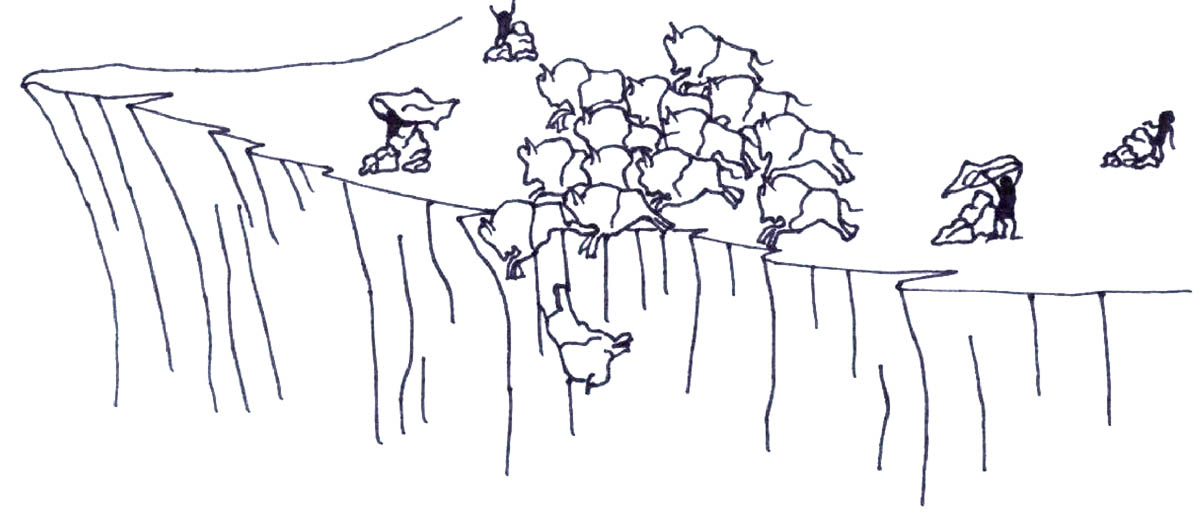
Background knowledge: To start the drive a buffalo runner would wear a wolf or buffalo skin as a disguise. The buffalo runner would get the attention of the lead cow and try to lure it closer. The curiosity of the new animal would make the lead cow follow it bringing the herd with her. As the lead cow got closer the buffalo runner would begin to move quickly away. When the buffalo herd moved closer to the cliff, the buffalo runner would discard the calf robe and run or jump to safety. Additional runners circled in the back and sides of the herd to frighten them towards the cliff by shouting, waving arms, and shooting arrows. As the buffalo stampeded towards the cliff they could not stop the momentum and by the time they realized their demise, it was too late.

 buffalo jump drawing


Archeological evidence at several buffalo jumps suggests that most jumps were conducted in the fall. Bones of mature cows and yearling calves are the most often uncovered at these dig sites. The fall, after the "rut" or mating season, is the time this herd structure is common.

Although hundreds of bison may have been killed in a single jump event, the people would use as much of the carcasses as possible. Hides would be used for clothing, shelter, and bedding. The hair and tail could be used to make rope and fly brushes. Sinew from the muscles made thread, glue, and bow strings. Bones and horns were used to make a variety of tools for everyday use. All of the meat was consumed some during the celebration and ceremonies of a successful kill, must most was dried for use during the winter. Almost every part of the animal was used.

As in all situations, change is inevitable and change for the Plains Indians method of hunting came with the horse. Horses were obtained by the Plains Indians early in the 1700s. Their use for hunting and as beasts of burden spread quickly among tribes throughout the continent, including the plains people.

Once horses were abundant, native people switched to a nomadic way of life rapidly. The use of horses allowed following the bison herds, hunting for fresh meat year round, as opposed to large communal hunts in the fall.
The bison jump quickly became an obsolete method for hunting bison. A skilled rider could target a single animal; the meat, hide, and all useful parts could be transported longer distances. Within a few decades, the plains people had become horse people.

By the time of westward expansion, the horse people of the plains were in their full glory and buffalo jumps were only stories of the courage and cooperation of their ancestors.


Materials:
Read         The Buffalo Jump
                 written by Peter Roop
                 and illustrated by Bill Farnsworth

 One ten-foot piece of string/yarn per student. Mark off 1-foot intervals with a piece of tape or a marker. This can be done either ahead of time or have students do it.

 One-stop watch or timer (to the second) per group off three. You could also teach students how to count…1-1000, 2-1000, etc.)

 Pack of sticky notes these would work best to make a graph later

 Roll of tape or something to mark where the runner starts and stops

 One pencil per group.

 A large area for running and measuring 50-100 yards.                                                                                          

Learning Activities:
1. Read aloud The Buffalo Jump written by Peter Roop and illustrated by Bill Farnsworth.
2. Discuss what units of measurement you would use to measure how far someone can run both long and
short distances. If you haven’t already measured out the string with one-foot intervals marked, you could
have the students do that now. This takes a little longer, but will give them practice measuring in one foot
increments with a ruler and ownership in making their measuring string.
3. Demonstrate how to cooperatively measure distances by laying the 10-foot strings end to end and
repeating the process over until you reach your measurement. Also demonstrate how to time the runners.
If you don’t have a stopwatch you can teach kids how to time by saying: 1--1000, 2—1000, …up
to…10--1000.
4. Divide the class into groups of three. They will each take turns being the “runner”, “timer”, and
“referee”.
 Mark off a starting line and have the “runner” line up behind the line.
 The timer will give a signal to the runner to start and start the time.
 The referee will follow the runner.
 When 10 seconds are up the timer says or signals the runner to stop.
 The referee marks off the spot the runner reached in 10 seconds.
 The group then works together with their yarn to measure the distance of the runner.
 The runner then writes down their name and the distance they ran in 10 seconds on a sticky note.
 Repeat the process until everyone has ran and measured.
5. Collect the sticky notes and use them to make a bar graph on the board. You could extend this activity by showing the class average and/or mode.
6. Discuss who would be a good buffalo runner and why?


Tuesday, December 20, 2016

How many licks?


Image result for candycane black and white                          Image result for candycane black and white


Every kid gets a candy cane today. We're going to look at it closely. How many colors do you see on your candy cane? What is the candy cane shaped as? What does it feel like? Close your eyes, does it smell like anything you recognize? Before you open it, trace it on a piece of paper. How long is a candy cane? Measure it with your ruler. You can cut out the traced candy cane and can you easily stretch out the crook and estimate how long it would be without the crook?


Today we're going to find out, how many licks does it take to eat a whole candy cane? We're going to color one candy cane for every lick and then we'll count. If there's not enough candy canes make tally marks to continue keeping track.

Image result for candycane black and white
Image result for candycane black and whiteImage result for candycane black and whiteImage result for candycane black and whiteImage result for candycane black and whiteImage result for candycane black and whiteImage result for candycane black and whiteImage result for candycane black and whiteImage result for candycane black and whiteImage result for candycane black and whiteImage result for candycane black and whiteImage result for candycane black and whiteImage result for candycane black and whiteImage result for candycane black and whiteImage result for candycane black and whiteImage result for candycane black and whiteImage result for candycane black and whiteImage result for candycane black and whiteImage result for candycane black and whiteImage result for candycane black and whiteImage result for candycane black and whiteImage result for candycane black and whiteImage result for candycane black and whiteImage result for candycane black and whiteImage result for candycane black and whiteImage result for candycane black and whiteImage result for candycane black and whiteImage result for candycane black and whiteImage result for candycane black and whiteImage result for candycane black and whiteImage result for candycane black and whiteImage result for candycane black and whiteImage result for candycane black and whiteImage result for candycane black and whiteImage result for candycane black and whiteImage result for candycane black and whiteImage result for candycane black and whiteImage result for candycane black and whiteImage result for candycane black and whiteImage result for candycane black and white